Fire Pits Under a Gazebo or Pergola
A roof over a fire changes three things at once: where the heat goes, where the smoke goes, and what happens if something catches. Here is the honest answer for each kind of structure.
DisclosureWe earn a commission when you buy through the links on this page, at no extra cost to you. Prices come from Amazon and change without notice. How this site is funded.
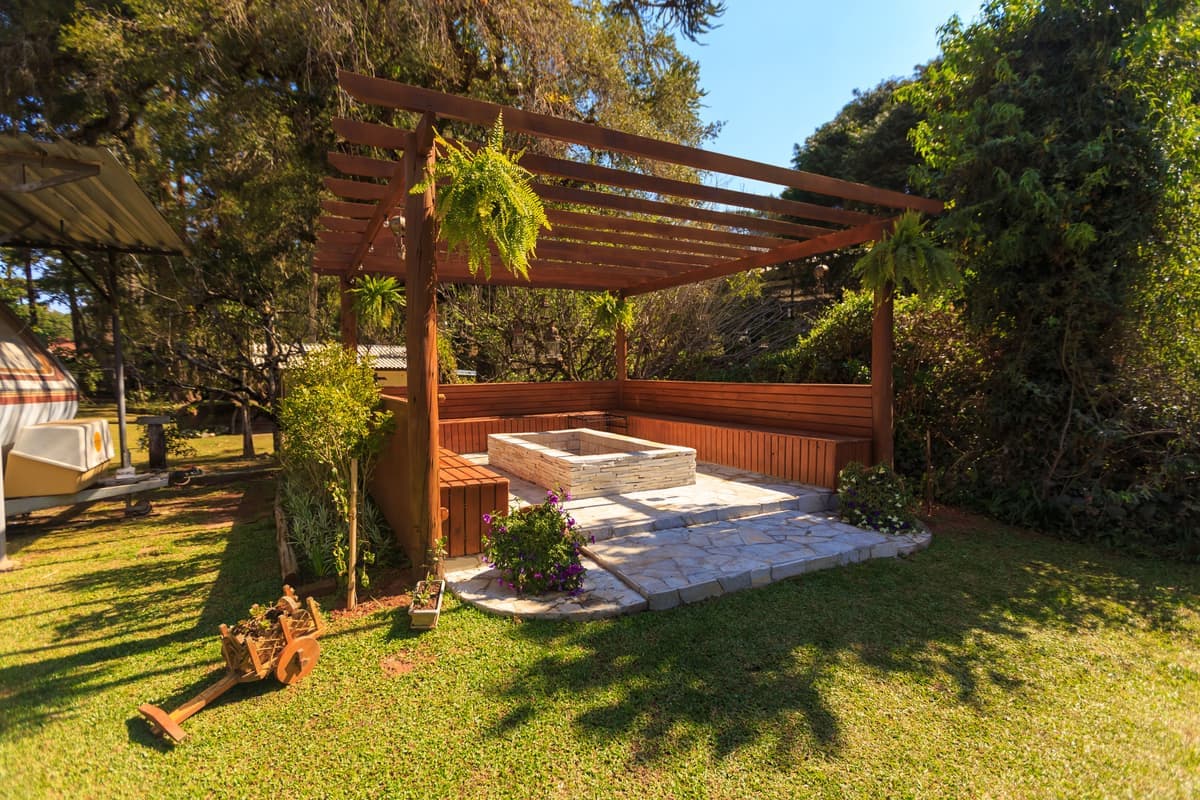
Not with wood. A wood fire under any roof is prohibited by essentially every manufacturer's instructions and is the hardest case there is. A gas fire pit under an open-slatted pergola, with real headroom and the manufacturer's clearances respected, is defensible. Under a solid-roofed gazebo or a fabric canopy, the honest answer is no.
Three different structures, three different answers
The word gazebo gets used for everything from a cedar pavilion with a shingled roof to a pop-up with a polyester top. They are not the same problem, and the answer changes completely between them.
| Structure | Wood fire | Gas fire | The deciding factor |
|---|---|---|---|
| Pergola, open slats | No | Defensible with headroom and clearance | Most heat and smoke escape between the slats |
| Gazebo, solid roof | No | Only with real height and manufacturer approval | Heat collects against the roof and has nowhere to go |
| Fabric or vinyl canopy | No | No | The roof itself is combustible and sits low |
| Open sky | Yes, with clearance | Yes, with clearance | The normal case — see the clearance guide |
If the roof is solid and low, the fuel type stops mattering. Height and venting are doing the work, not the fire.
What the code says
The International Fire Code does not have a gazebo clause. It has a structure clause, and a gazebo is a structure. Both of the sections that apply to backyard fires are written in terms of distance from a structure or combustible material, and a roof is both.
That last point is the one people miss. The residential exception removes the 15-foot number for a manufactured pit at a normal house. It does not remove the requirement to follow the manual, and essentially every wood pit manual says not to use the product under an overhead structure. The full clearance picture, including which fires count as which, is in how far a fire pit should be from the house.
Why a roof is harder than a wall
A fire radiates in every direction, but it convects upward — the hot gas column above a fire carries far more energy than the sideways radiance does. A wall beside a fire takes radiant heat only. A roof above it takes the entire plume.
That plume is also the thing that has nowhere to go under a solid roof. It spreads out against the underside, so instead of one hot spot you get a heated area, and the heat stays there for as long as the fire burns. The critical number is not the flame temperature, which is enormous and mostly irrelevant here. It is that wood only needs to reach about 392°F to begin smoldering, sustained radiant heat will get it there, and smoldering wood does not look like fire. The published figures are set out in how hot does a fire pit get.
The smoke problem, which arrives first
Long before anything is dangerous, a roof makes a fire unpleasant. Smoke that would drift away rises, hits the roof, spreads sideways and comes back down around the edges — which is to say, onto everybody sitting there. Under a solid-roofed gazebo, a wood fire that behaves perfectly in the open becomes unusable.
Gas produces almost no smoke, which is why it is the format that works here at all. If you are weighing that trade more broadly, wood vs propane covers it, and smoke and smell explains why even a smokeless pit is not a solution to this particular problem.
If you are going to do it, do it like this
- 1Read the manual for your specific pit first. It governs, and it is the document your insurer will ask about.
- 2Use gas, not wood. No embers, no plume of sparks, and it stops the moment you close the valve.
- 3Measure your headroom. Open-slatted pergolas vent; low solid roofs do not. If you cannot stand comfortably under it with the fire lit, it is too low.
- 4Keep it to the open-sided cases. Three walls and a roof is an enclosure, and an enclosure with a burning appliance in it is a different and much more serious question.
- 5Never use a canopy, fabric top or vinyl roof. There is no configuration of this that is acceptable.
- 6Watch what is stored above. Pergolas collect climbing plants, string lights and stacked cushions. Dry vine on a beam above a fire is kindling in a bad place.
The formats that make this defensible
Ranked on fuel format first, then on how completely you can control the fire. Everything here runs on gas or fuel canisters, because a pit that cannot throw an ember is the entire point under a roof. None of this overrides your own manual or your local fire authority.
| # | Product | Best for | Key spec | Price |
|---|---|---|---|---|
| 1 | 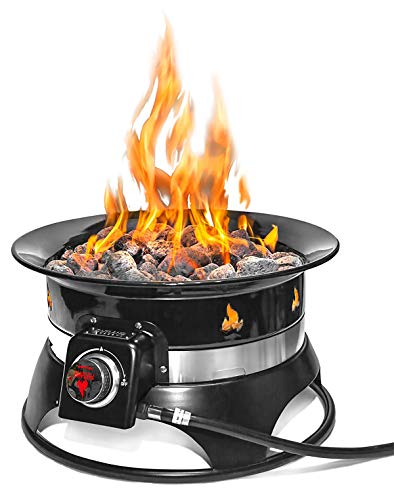 Outland Living Firebowl 870 PremiumThe 19 in Outland with auto-ignition instead of a match. Worth it if you light the pit often, irrelevant if you do not. | Push-button starts | 58,000 BTU/hr | $199.99 · View on Amazon |
| 2 |  Outland Living Firebowl 893 Deluxe58,000 BTU, CSA-certified, and the pit most often accepted where wood fires are not. The cover and carry kit are in the box, which is why this is the one to buy over the bare 823. | Burn bans and travel | 58,000 BTU/hr | $159.99 · View on Amazon |
| 3 |  Gas One 23 in Alloy Steel Wood-Burning Fire PitA 23 in alloy-steel bowl at the bottom of the market. It is the cheapest verified wood pit on this site, and the price is the whole argument. | The lowest honest entry price | Alloy steel | $39.99 · View on Amazon |
| 4 |  TLGREEN 30 in Round Propane Fire Pit Table, 50,000 BTUThe fire-table format at 50,000 BTU instead of the category-standard 30,000. It closes most of the heat gap with a bowl, and it costs you runtime to do it. | Table format, more heat | 50,000 BTU/hr | $249.99 · View on Amazon |
| 5 |  Solo Stove Mesa, 5.1 in Tabletop Fire PitThe tabletop pit most people are searching for: 5.1 in of stainless, 1.4 lb, burning wood or pellets, with the stand in the box. A decorative fire, not a heat source. | A real flame on a table | Stainless steel | $70.99 · View on Amazon |
Prices are pulled live from Amazon. Where no live price is showing, the button reads “check price” rather than a number we cannot stand behind.
Outland Living Firebowl 870 Premium
Outland LivingThe 19 in Outland with auto-ignition instead of a match. Worth it if you light the pit often, irrelevant if you do not.
The 19 in Outland with auto-ignition instead of a match. Worth it if you light the pit often, irrelevant if you do not.
- No lighter, and no reaching over a burner
- The same certified burner as the rest of the range
- Cover and carry kit included
- An igniter is one more thing that can fail, and it is not separately warranted
- Costs more than the 893 for a convenience feature
Households that light the pit weekly rather than monthly.
You are fine with a long lighter. The 893 is the same fire for less.
We have not burned this unit. These are the things a specification sheet cannot answer, listed rather than glossed over.
- Igniter reliability over several seasons
#ad how we are funded · price as of October 18, 2026
Outland Living Firebowl 893 Deluxe
Outland Living58,000 BTU, CSA-certified, and the pit most often accepted where wood fires are not. The cover and carry kit are in the box, which is why this is the one to buy over the bare 823.
58,000 BTU, CSA-certified, and the pit most often accepted where wood fires are not. The cover and carry kit are in the box, which is why this is the one to buy over the bare 823.
- CSA certification is the thing an HOA or a campground manager actually asks to see
- No embers, so it is the defensible choice under a covered patio and during most burn bans
- Shuts off instantly, which removes the entire put-it-out problem
- A 1-year warranty is the shortest in this whole registry
- A 20 lb tank has to live somewhere, and the hose length dictates where the pit can sit
- 58,000 BTU is a burner rating, not a measure of how warm you will feel
Anyone in a burn-ban county, on a covered patio, in an HOA, or towing it to a campsite.
You want the smell and the sound of a wood fire. A gas flame is not a substitute, and pretending otherwise wastes your money.
We have not burned this unit. These are the things a specification sheet cannot answer, listed rather than glossed over.
- Real-world runtime, which depends on how low you run the burner. Our figure is arithmetic at full output
- Long-run corrosion on the powder-coated bowl in coastal air
#ad how we are funded · price as of October 18, 2026
Gas One 23 in Alloy Steel Wood-Burning Fire Pit
Gas OneA 23 in alloy-steel bowl at the bottom of the market. It is the cheapest verified wood pit on this site, and the price is the whole argument.
A 23 in alloy-steel bowl at the bottom of the market. It is the cheapest verified wood pit on this site, and the price is the whole argument.
- Cheaper than most spark screens, which reframes what a first fire pit has to cost
- 23 in is a usable diameter rather than a token one
- Alloy steel is at least stated, which the very cheapest listings often will not do
- No screen, poker or grate stated — budget for a screen separately if your rules need one
- No stated gauge, so wall thickness is unknown and thin steel is how cheap pits die
- Stock has been running low, so availability is less dependable than the established brands
A first fire pit, a rental, or anywhere you are not sure you will still want one next year.
You want something that still looks right in five years. At this price that is not the deal.
We have not burned this unit. These are the things a specification sheet cannot answer, listed rather than glossed over.
- Steel gauge and finish, both unpublished
- How many seasons the bowl survives, with no warranty stated to fall back on
#ad how we are funded · price as of October 18, 2026
TLGREEN 30 in Round Propane Fire Pit Table, 50,000 BTU
TLGREENThe fire-table format at 50,000 BTU instead of the category-standard 30,000. It closes most of the heat gap with a bowl, and it costs you runtime to do it.
The fire-table format at 50,000 BTU instead of the category-standard 30,000. It closes most of the heat gap with a bowl, and it costs you runtime to do it.
- 50,000 BTU/hr is two-thirds more output than the 30,000 BTU tables that define this category
- 30 in round is the standard fire-table footprint, so covers and surrounds fit
- Priced alongside the 30,000 BTU tables rather than above them
- Runtime per tank drops from about 14 hours at 30,000 BTU to about 9 here
- The listing states no warranty term, so there is nothing to hold anyone to
- A newer brand with far less of a track record than the established table makers
Someone who wants a table but is not willing to give up the heat to get one.
You refill tanks reluctantly. A 30,000 BTU table lasts far longer per cylinder.
We have not burned this unit. These are the things a specification sheet cannot answer, listed rather than glossed over.
- What ships in the box. The listing does not enumerate a cover, lid or media
- Long-run finish durability on the tabletop
- Whether the base conceals a 20 lb cylinder, which the listing does not state
#ad how we are funded · price as of October 18, 2026
Solo Stove Mesa, 5.1 in Tabletop Fire Pit
Solo StoveThe tabletop pit most people are searching for: 5.1 in of stainless, 1.4 lb, burning wood or pellets, with the stand in the box. A decorative fire, not a heat source.
The tabletop pit most people are searching for: 5.1 in of stainless, 1.4 lb, burning wood or pellets, with the stand in the box. A decorative fire, not a heat source.
- The stand is in the box, and on a table the stand is what keeps heat off the surface
- Pellets make a chamber this small workable — split wood essentially does not fit
- 1.4 lb, so it moves off the table the moment dinner needs the space
- 5.1 in is a candle-scale fire. It will not warm anyone, and it is not trying to
- A chamber this small needs feeding every few minutes
- Bare stainless heat-stains to straw and blue over the fire; the coated colorways hide that, this one does not
An outdoor dining table or patio where you want a small live flame as a centerpiece.
You want warmth, or anything indoors. It is a wood-burning appliance and it is outdoor-only.
We have not burned this unit. These are the things a specification sheet cannot answer, listed rather than glossed over.
- Burn time per load, which no maker publishes and which depends entirely on the fuel
- How much heat the included stand actually keeps off the table, which Solo Stove does not publish
#ad how we are funded · price as of October 18, 2026
What we would skip
- A wood-burning fire pit under any solid roof
Embers go up. A roof stops them going anywhere else and holds the heat against itself all evening. Essentially every wood pit manual prohibits use under an overhead structure, which also means your homeowner's insurance has a clear position on it.
- A fire pit under a fabric or vinyl canopy
Soft-top gazebos and canopies are the worst case. The material is combustible, it sits low, and it can melt and drip onto the fire long before anything ignites. No fuel type makes this reasonable.
- Treating a pergola as though it were open sky
Open slats vent most of the heat, but the beams directly above the fire still take sustained radiant heat evening after evening. Wood only needs to reach about 392°F to begin smoldering, and that can happen with no ember ever touching it.
How we judged these
- Picks are ranked on fuel format first — because under a roof the question of whether a pit throws embers matters more than anything else about it.
- Then on controllability: a fire you can shut off at a valve is a fundamentally different proposition under a structure than one that has to burn down.
- Then on published output and size, quoted from the current retail listing and cited on that product's own spec sheet.
- What we did not do: test clearances, measure a roof temperature, or verify any manufacturer's instruction beyond what the listing states. Read your own manual — it governs.
We have not burned any of these units, and we do not claim to have. The full method, including what it cannot tell you.