Fire Pits Under a Covered Patio
This is the one placement where the fuel decision is made for you. Wood is out. Gas is a maybe, and the maybe belongs to the manufacturer, not to us.
DisclosureWe earn a commission when you buy through the links on this page, at no extra cost to you. Prices come from Amazon and change without notice. How this site is funded.
Not with wood. An ember-producing fire under a roof has nowhere for sparks or heat to go, and no barrier addresses it. A certified gas pit is often acceptable, but many manuals prohibit any overhead structure — the manual for your specific model is the authority, not a general rule.
Why solid fuel is simply out
Three reasons, and each on its own is sufficient. Embers rise. A wood fire lofts sparks upward on the convective plume, and a roof is where they arrive. Rafters, joists and any accumulated debris up there are exactly the fuel you do not want to introduce a spark to. Heat accumulates. Under an open sky the plume disperses; under a roof it collects at ceiling level and stays hot, on timber. Smoke has nowhere to go. The plume that would rise and disperse instead fills the covered space, which makes it unusable and, in an enclosed porch, genuinely unhealthy.
A screened porch is worse still, because the screens restrict airflow further while doing nothing to stop heat. There is no product configuration that makes a wood fire acceptable in that space, and we are not going to describe one.
Gas is a different question, and the answer is in the manual
A gas fire pit removes two of those three problems entirely: no embers, no smoke. What remains is heat, and heat under a ceiling is a clearance question rather than a categorical prohibition. That is why gas is often acceptable under a covered patio while wood never is.
It is also why the answer varies by product. Some gas pit manuals specify a minimum overhead clearance and permit use under a structure that meets it. Others prohibit any overhead structure at all, unconditionally. Both exist, and the difference is a manufacturer's engineering decision about that appliance. Read the manual for the model you are buying — this is one of the few places on this site where we cannot give you a general answer, because there genuinely is not one.
| Space | Wood / smokeless | Certified gas |
|---|---|---|
| Open sky | Yes, with clearance | Yes |
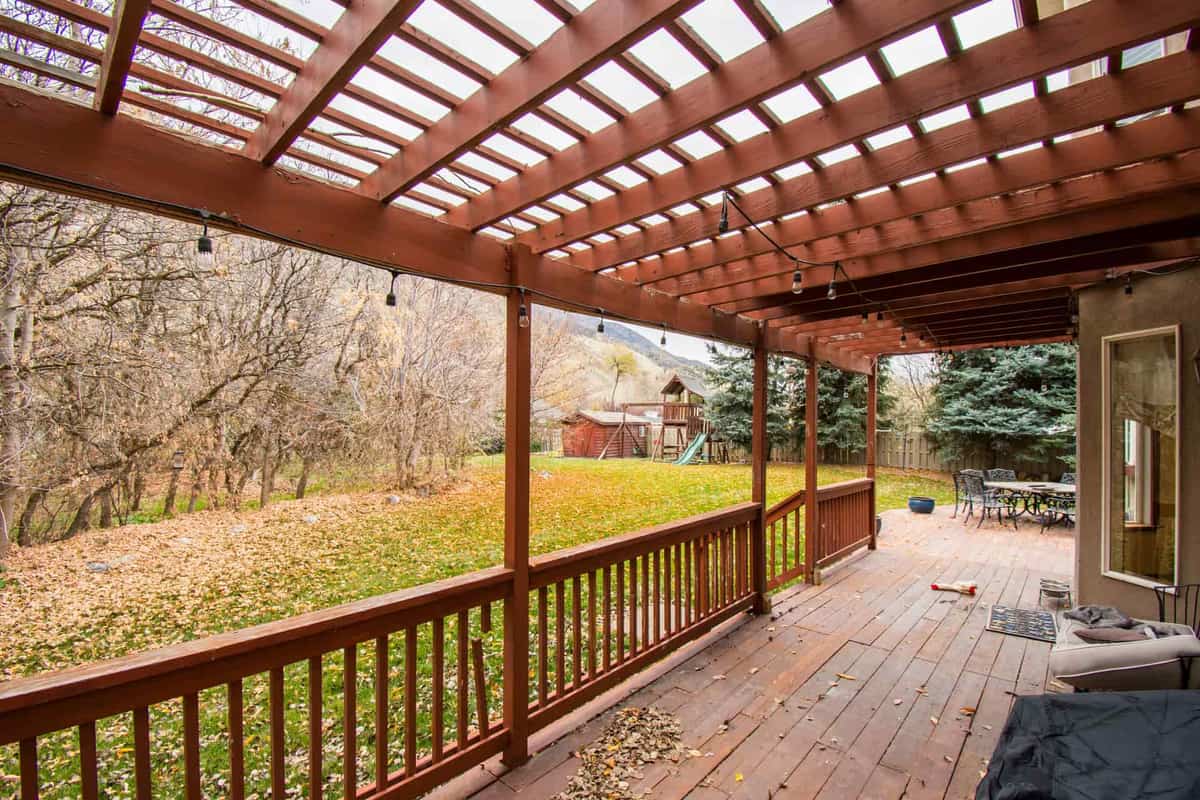
| Pergola with open slats | No — the slats are combustible and above a fire | Often, per the manual |
| Solid-roofed patio, open sides | No | Often, per the manual, with ceiling clearance |
| Screened porch | No | Frequently prohibited — check carefully |
| Garage, carport or anything enclosed | No | No |
'Per the manual' means exactly that. Several gas fire pit manuals prohibit any overhead structure regardless of height.
The ventilation question people do not ask
Any fuel-burning appliance consumes oxygen and produces combustion products, including carbon monoxide. Outdoors under an open sky this is a non-issue — dispersal is effectively infinite. Under a solid roof with three open sides it is still fine in practice. In a screened porch or any space that is substantially enclosed, it stops being obviously fine, and that is precisely the space people most want to use a fire pit in.
For a screened porch specifically: screens restrict air exchange more than people expect, the manufacturer almost certainly did not test the appliance in that configuration, and the manual likely prohibits it. If the manual does not clearly permit it, treat that as a no.
The alternative that is actually designed for this
If the space is covered and the goal is warmth, a patio heater is the appliance built for the situation — many are rated for use under a roof with a specified clearance, which is the opposite of most fire pits. It will not give you a flame to sit around, and it will make a covered patio comfortable in a way a fire pit under a roof was never going to. Fire pit vs patio heater.
If you are going ahead with gas
- 1Read the manual before buying. Whether the model permits overhead structure is a purchase-deciding specification and it is rarely on the listing.
- 2Measure the ceiling clearance the manual specifies, from the top of the flame, not from the rim.
- 3Check what the ceiling is made of and whether it has been treated. Painted timber and plastic paneling behave differently.
- 4Keep at least two sides genuinely open.
- 5Clear the space above — nothing stored in the rafters over a fire.
- 6Check the HOA covenant too. Several prohibit open flame under structures regardless of fuel. HOA rules.
Gas pits for a covered space
If the patio is only partly covered, or you have not settled on what goes on it yet, the wider list weighs cover against surface and clearance together rather than one at a time. The best fire pits for a patio.
| # | Product | Best for | Key spec | Price |
|---|---|---|---|---|
| 1 |  Outland Living Firebowl 893 Deluxe58,000 BTU, CSA-certified, and the pit most often accepted where wood fires are not. The cover and carry kit are in the box, which is why this is the one to buy over the bare 823. | Burn bans and travel | 58,000 BTU/hr | $159.99 · View on Amazon |
| 2 |  Endless Summer 30 in Gas Fire Pit TableA 30 in table whose base swallows the 20 lb cylinder. That is the entire point of a fire table, and it is the reason to pay the premium over a bowl. | Hiding the tank | 30,000 BTU/hr | $229.99 · View on Amazon |
| 3 |  TLGREEN 30 in Round Propane Fire Pit Table, 50,000 BTUThe fire-table format at 50,000 BTU instead of the category-standard 30,000. It closes most of the heat gap with a bowl, and it costs you runtime to do it. | Table format, more heat | 50,000 BTU/hr | $249.99 · View on Amazon |
Prices are pulled live from Amazon. Where no live price is showing, the button reads “check price” rather than a number we cannot stand behind.
Outland Living Firebowl 893 Deluxe
Outland Living58,000 BTU, CSA-certified, and the pit most often accepted where wood fires are not. The cover and carry kit are in the box, which is why this is the one to buy over the bare 823.
58,000 BTU, CSA-certified, and the pit most often accepted where wood fires are not. The cover and carry kit are in the box, which is why this is the one to buy over the bare 823.
- CSA certification is the thing an HOA or a campground manager actually asks to see
- No embers, so it is the defensible choice under a covered patio and during most burn bans
- Shuts off instantly, which removes the entire put-it-out problem
- A 1-year warranty is the shortest in this whole registry
- A 20 lb tank has to live somewhere, and the hose length dictates where the pit can sit
- 58,000 BTU is a burner rating, not a measure of how warm you will feel
Anyone in a burn-ban county, on a covered patio, in an HOA, or towing it to a campsite.
You want the smell and the sound of a wood fire. A gas flame is not a substitute, and pretending otherwise wastes your money.
We have not burned this unit. These are the things a specification sheet cannot answer, listed rather than glossed over.
- Real-world runtime, which depends on how low you run the burner. Our figure is arithmetic at full output
- Long-run corrosion on the powder-coated bowl in coastal air
#ad how we are funded · price as of October 18, 2026
Endless Summer 30 in Gas Fire Pit Table
Endless SummerA 30 in table whose base swallows the 20 lb cylinder. That is the entire point of a fire table, and it is the reason to pay the premium over a bowl.
A 30 in table whose base swallows the 20 lb cylinder. That is the entire point of a fire table, and it is the reason to pay the premium over a bowl.
- The cylinder and the control panel disappear, which is the whole design brief
- 30,000 BTU nearly doubles runtime per tank against a 58,000 BTU bowl
- The ledge around the burner is usable surface, unlike a bowl
- 30,000 BTU is genuinely less heat, not just a slower burn
- 24 in tall and heavy, so this does not travel
- Fire glass and lava rock are consumables that discolor
A patio where the pit doubles as the table and the propane tank must not be visible.
Heat is the priority. Buy BTU in a bowl instead.
We have not burned this unit. These are the things a specification sheet cannot answer, listed rather than glossed over.
- Resin mantel durability under direct sun over several seasons
- Whether the enclosed base affects tank temperature in hot weather. The listing does not say
#ad how we are funded · price as of October 18, 2026
TLGREEN 30 in Round Propane Fire Pit Table, 50,000 BTU
TLGREENThe fire-table format at 50,000 BTU instead of the category-standard 30,000. It closes most of the heat gap with a bowl, and it costs you runtime to do it.
The fire-table format at 50,000 BTU instead of the category-standard 30,000. It closes most of the heat gap with a bowl, and it costs you runtime to do it.
- 50,000 BTU/hr is two-thirds more output than the 30,000 BTU tables that define this category
- 30 in round is the standard fire-table footprint, so covers and surrounds fit
- Priced alongside the 30,000 BTU tables rather than above them
- Runtime per tank drops from about 14 hours at 30,000 BTU to about 9 here
- The listing states no warranty term, so there is nothing to hold anyone to
- A newer brand with far less of a track record than the established table makers
Someone who wants a table but is not willing to give up the heat to get one.
You refill tanks reluctantly. A 30,000 BTU table lasts far longer per cylinder.
We have not burned this unit. These are the things a specification sheet cannot answer, listed rather than glossed over.
- What ships in the box. The listing does not enumerate a cover, lid or media
- Long-run finish durability on the tabletop
- Whether the base conceals a 20 lb cylinder, which the listing does not state
#ad how we are funded · price as of October 18, 2026
- Only gas pits appear here, because no solid-fuel pit is defensible under a roof.
- Ranked on certification first, then burner rating.
- What we did not do: operate anything under cover, or measure air quality.
We have not burned any of these units, and we do not claim to have. The full method, including what it cannot tell you.