Fire Pit vs Patio Heater
If the goal is genuinely to be warm outdoors, the heater wins and it is not close. If the goal is to sit around something, the heater loses entirely.
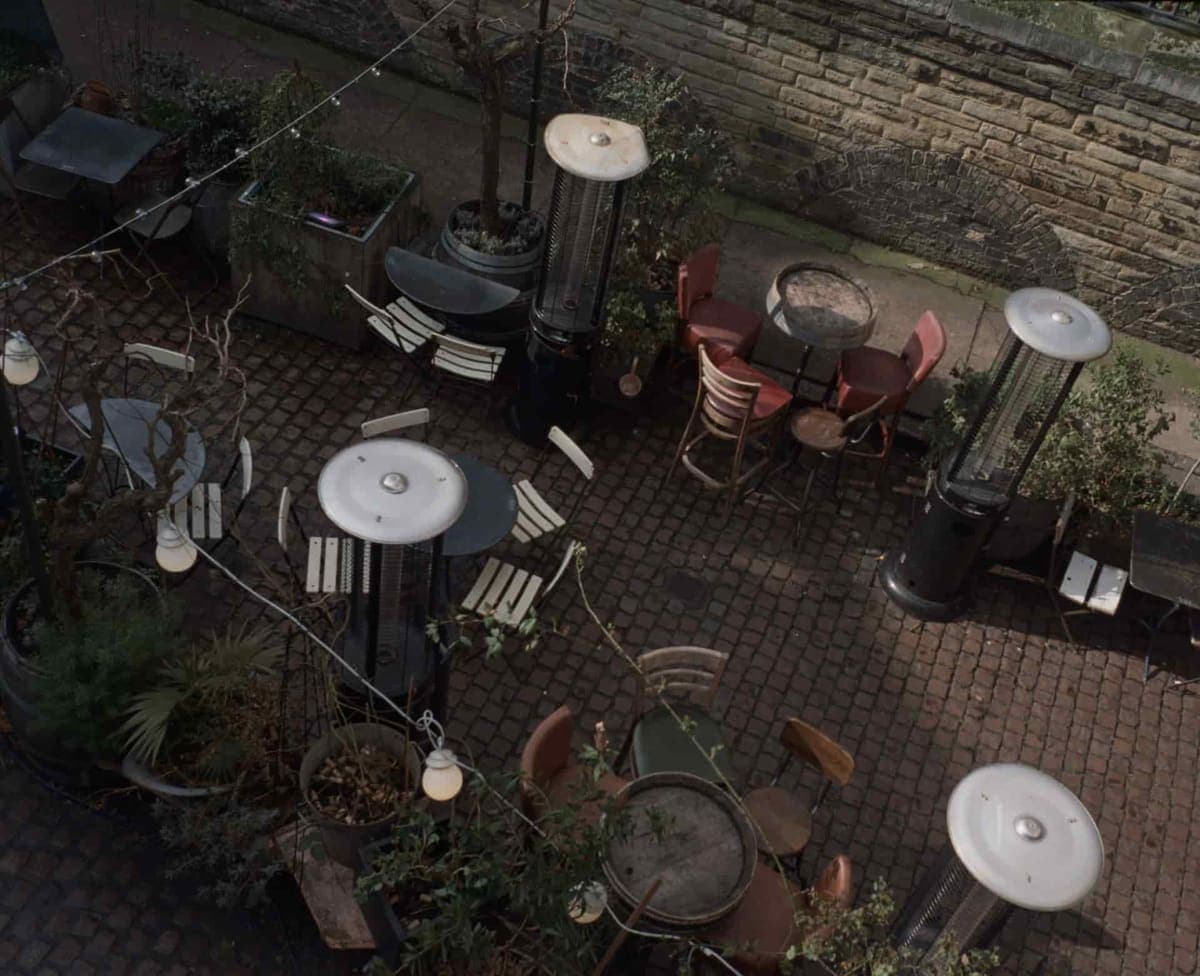
DisclosureWe earn a commission when you buy through the links on this page, at no extra cost to you. Prices come from Amazon and change without notice. How this site is funded.
A patio heater points its output downward at the people underneath, so most of the energy reaches you. A fire pit radiates in every direction from ground level, so most of it does not. For pure warmth per hour the heater wins comfortably. For everything else about being outside at night, the fire pit wins.
The difference is geometry, not output
Both appliances run similar burners on the same fuel — a mushroom-style patio heater and a large propane fire pit are often within a few thousand BTU of each other. What differs is where the heat goes. A patio heater puts the burner at head height under a reflector shaped to direct radiant energy downward into a defined circle. Almost everything it produces lands on people.
A fire pit sits at ankle height and radiates outward in every direction, and a large share of its energy goes straight up as a convective plume. The portion that reaches a seated person is the fraction that happens to be aimed at them. That is why you can be too hot on the shins and cold on the shoulders at the same fire.
| Fire pit | Patio heater | |
|---|---|---|
| Heat direction | All directions from ground level | Downward into a defined circle |
| Warmth per BTU delivered to people | Low | High |
| Warms your upper body | Poorly | Well |
| Works in wind | Poorly | Better, though still affected |
| Height | Ankle level | About 7 ft |
| People sit around it | Yes — it is the focal point | No — they sit under it |
| Flame you can watch | Yes | Barely |
| Cooking | On a wood pit, yes | No |
| Cost to run | Similar on the same fuel | Similar |
The honest recommendation
If someone tells us they want to extend their patio season into cold weather and be comfortable out there, the right answer is a patio heater, and we are not going to pretend otherwise to sell a fire pit. It delivers more usable warmth to more people per hour, it warms your torso rather than your feet, and it does not need tending.
But almost nobody actually wants that. What people want is somewhere to sit outside in the evening with a focal point — and a patio heater is not a focal point, it is an appliance overhead that you stop noticing. A fire is the thing people arrange chairs around, and it is the reason the whole category exists.
If you buy the fire pit, buy warmth deliberately
- 1Sit closer. Radiant heat falls off with the square of the distance, so moving from six feet to four roughly doubles what reaches you. This matters more than any product difference.
- 2Buy diameter, not BTU. On a wood pit, fire area is what radiates. On a gas pit, the burner rating is real but distance still dominates.
- 3Get the fire off the ground. A pit on a stand puts the radiating surface closer to seated height.
- 4Block the wind. A wind screen or a fence on the windward side is worth more than a bigger burner.
- 5Use a pit with a tall outer wall, which radiates sideways at the height you sit. Where the heat goes in a double-wall pit.
What about the covered-patio case?
This is where the comparison gets practical rather than philosophical. A patio heater is designed to operate under a roof with adequate clearance, and many are rated for it. A solid-fuel fire pit never is. A gas fire pit sometimes is, subject to the manual. If the space you want to warm is covered, the heater is very likely the only appliance you can legitimately use there. Covered patios and screened porches.
The gas pits, if you want the fire
| # | Product | Best for | Key spec | Price |
|---|---|---|---|---|
| 1 |  Outland Living Firebowl 893 Deluxe58,000 BTU, CSA-certified, and the pit most often accepted where wood fires are not. The cover and carry kit are in the box, which is why this is the one to buy over the bare 823. | Burn bans and travel | 58,000 BTU/hr | $159.99 · View on Amazon |
| 2 |  TLGREEN 30 in Round Propane Fire Pit Table, 50,000 BTUThe fire-table format at 50,000 BTU instead of the category-standard 30,000. It closes most of the heat gap with a bowl, and it costs you runtime to do it. | Table format, more heat | 50,000 BTU/hr | $249.99 · View on Amazon |
Prices are pulled live from Amazon. Where no live price is showing, the button reads “check price” rather than a number we cannot stand behind.
Outland Living Firebowl 893 Deluxe
Outland Living58,000 BTU, CSA-certified, and the pit most often accepted where wood fires are not. The cover and carry kit are in the box, which is why this is the one to buy over the bare 823.
58,000 BTU, CSA-certified, and the pit most often accepted where wood fires are not. The cover and carry kit are in the box, which is why this is the one to buy over the bare 823.
- CSA certification is the thing an HOA or a campground manager actually asks to see
- No embers, so it is the defensible choice under a covered patio and during most burn bans
- Shuts off instantly, which removes the entire put-it-out problem
- A 1-year warranty is the shortest in this whole registry
- A 20 lb tank has to live somewhere, and the hose length dictates where the pit can sit
- 58,000 BTU is a burner rating, not a measure of how warm you will feel
Anyone in a burn-ban county, on a covered patio, in an HOA, or towing it to a campsite.
You want the smell and the sound of a wood fire. A gas flame is not a substitute, and pretending otherwise wastes your money.
We have not burned this unit. These are the things a specification sheet cannot answer, listed rather than glossed over.
- Real-world runtime, which depends on how low you run the burner. Our figure is arithmetic at full output
- Long-run corrosion on the powder-coated bowl in coastal air
#ad how we are funded · price as of October 18, 2026
TLGREEN 30 in Round Propane Fire Pit Table, 50,000 BTU
TLGREENThe fire-table format at 50,000 BTU instead of the category-standard 30,000. It closes most of the heat gap with a bowl, and it costs you runtime to do it.
The fire-table format at 50,000 BTU instead of the category-standard 30,000. It closes most of the heat gap with a bowl, and it costs you runtime to do it.
- 50,000 BTU/hr is two-thirds more output than the 30,000 BTU tables that define this category
- 30 in round is the standard fire-table footprint, so covers and surrounds fit
- Priced alongside the 30,000 BTU tables rather than above them
- Runtime per tank drops from about 14 hours at 30,000 BTU to about 9 here
- The listing states no warranty term, so there is nothing to hold anyone to
- A newer brand with far less of a track record than the established table makers
Someone who wants a table but is not willing to give up the heat to get one.
You refill tanks reluctantly. A 30,000 BTU table lasts far longer per cylinder.
We have not burned this unit. These are the things a specification sheet cannot answer, listed rather than glossed over.
- What ships in the box. The listing does not enumerate a cover, lid or media
- Long-run finish durability on the tabletop
- Whether the base conceals a 20 lb cylinder, which the listing does not state
#ad how we are funded · price as of October 18, 2026
- Compared on how each one delivers heat, not on published output alone.
- Both picks are fire pits, because that is what this site covers — the case for a heater is made in the text where it is genuinely the better answer.
- What we did not do: measure temperature under either.
We have not burned any of these units, and we do not claim to have. The full method, including what it cannot tell you.