Burn Bans and Fire Pits
Most bans prohibit wood and exempt certified gas. Some prohibit everything with a flame. The difference is in the wording of the specific order, and it changes weekly.
DisclosureWe earn a commission when you buy through the links on this page, at no extra cost to you. Prices come from Amazon and change without notice. How this site is funded.
Most burn bans prohibit open burning of solid fuel and exempt self-contained gas appliances with a shut-off valve, so a certified propane pit is often still legal when a wood fire is not. A total or emergency restriction prohibits everything with a flame. The wording of the specific order is what decides it.
| # | Product | Best for | Key spec | Price |
|---|---|---|---|---|
| 1 |  Outland Living Firebowl 893 Deluxe58,000 BTU, CSA-certified, and the pit most often accepted where wood fires are not. The cover and carry kit are in the box, which is why this is the one to buy over the bare 823. | Burn bans and travel | 58,000 BTU/hr | $159.99 · View on Amazon |
| 2 |  Endless Summer 30 in Gas Fire Pit TableA 30 in table whose base swallows the 20 lb cylinder. That is the entire point of a fire table, and it is the reason to pay the premium over a bowl. | Hiding the tank | 30,000 BTU/hr | $229.99 · View on Amazon |
| 3 | 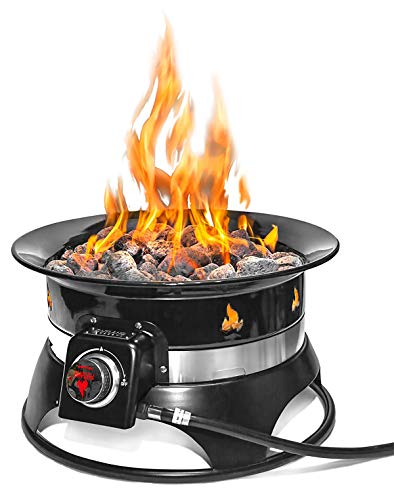 Outland Living Firebowl 870 PremiumThe 19 in Outland with auto-ignition instead of a match. Worth it if you light the pit often, irrelevant if you do not. | Push-button starts | 58,000 BTU/hr | $199.99 · View on Amazon |
Prices are pulled live from Amazon. Where no live price is showing, the button reads “check price” rather than a number we cannot stand behind.
Outland Living Firebowl 893 Deluxe
Outland Living58,000 BTU, CSA-certified, and the pit most often accepted where wood fires are not. The cover and carry kit are in the box, which is why this is the one to buy over the bare 823.
58,000 BTU, CSA-certified, and the pit most often accepted where wood fires are not. The cover and carry kit are in the box, which is why this is the one to buy over the bare 823.
- CSA certification is the thing an HOA or a campground manager actually asks to see
- No embers, so it is the defensible choice under a covered patio and during most burn bans
- Shuts off instantly, which removes the entire put-it-out problem
- A 1-year warranty is the shortest in this whole registry
- A 20 lb tank has to live somewhere, and the hose length dictates where the pit can sit
- 58,000 BTU is a burner rating, not a measure of how warm you will feel
Anyone in a burn-ban county, on a covered patio, in an HOA, or towing it to a campsite.
You want the smell and the sound of a wood fire. A gas flame is not a substitute, and pretending otherwise wastes your money.
We have not burned this unit. These are the things a specification sheet cannot answer, listed rather than glossed over.
- Real-world runtime, which depends on how low you run the burner. Our figure is arithmetic at full output
- Long-run corrosion on the powder-coated bowl in coastal air
#ad how we are funded · price as of October 18, 2026
Endless Summer 30 in Gas Fire Pit Table
Endless SummerA 30 in table whose base swallows the 20 lb cylinder. That is the entire point of a fire table, and it is the reason to pay the premium over a bowl.
A 30 in table whose base swallows the 20 lb cylinder. That is the entire point of a fire table, and it is the reason to pay the premium over a bowl.
- The cylinder and the control panel disappear, which is the whole design brief
- 30,000 BTU nearly doubles runtime per tank against a 58,000 BTU bowl
- The ledge around the burner is usable surface, unlike a bowl
- 30,000 BTU is genuinely less heat, not just a slower burn
- 24 in tall and heavy, so this does not travel
- Fire glass and lava rock are consumables that discolor
A patio where the pit doubles as the table and the propane tank must not be visible.
Heat is the priority. Buy BTU in a bowl instead.
We have not burned this unit. These are the things a specification sheet cannot answer, listed rather than glossed over.
- Resin mantel durability under direct sun over several seasons
- Whether the enclosed base affects tank temperature in hot weather. The listing does not say
#ad how we are funded · price as of October 18, 2026
Outland Living Firebowl 870 Premium
Outland LivingThe 19 in Outland with auto-ignition instead of a match. Worth it if you light the pit often, irrelevant if you do not.
The 19 in Outland with auto-ignition instead of a match. Worth it if you light the pit often, irrelevant if you do not.
- No lighter, and no reaching over a burner
- The same certified burner as the rest of the range
- Cover and carry kit included
- An igniter is one more thing that can fail, and it is not separately warranted
- Costs more than the 893 for a convenience feature
Households that light the pit weekly rather than monthly.
You are fine with a long lighter. The 893 is the same fire for less.
We have not burned this unit. These are the things a specification sheet cannot answer, listed rather than glossed over.
- Igniter reliability over several seasons
#ad how we are funded · price as of October 18, 2026
What a burn ban actually is
A burn ban is a temporary restriction issued when conditions make fire dangerous — drought, low humidity, high wind, or poor air quality. It is a separate mechanism from your fire code, issued by a different body, and it can prohibit things the fire code permits. Depending where you live it comes from a state forestry agency, a county commission, a fire district or an air-quality management district, and sometimes more than one at once.
Two features matter practically. It is temporary, which means checking once tells you nothing about next month. And it is local, sometimes down to the county or the fire district, so a ban twenty miles away may or may not apply to you.
The levels, and what each usually covers
| Level | Open burning | Wood fire pit | Charcoal | Certified gas pit |
|---|---|---|---|---|
| No restriction | Permitted | Permitted | Permitted | Permitted |
| Partial / stage 1 | Prohibited | Often prohibited | Often permitted | Usually permitted |
| Full / stage 2 | Prohibited | Prohibited | Prohibited | Usually permitted |
| Total / emergency | Prohibited | Prohibited | Prohibited | Often prohibited too |
Terminology varies enormously between agencies — 'stage 1', 'partial', 'restricted' and 'red flag' mean different things in different places. This table shows the usual shape, not the rule where you live.
The pattern across all of them is consistent: the concern is embers and airborne particulates. A wood fire produces both and gets restricted first. A gas appliance produces neither and gets restricted last, and often not at all. That is why the exemption exists and why it is worded around self-contained appliances with a shut-off valve rather than around 'gas' generally.
Smokeless pits are not exempt
The same applies to elevated mesh camping pits, chimineas and anything else that burns wood in a container. Containment reduces ember risk, which is why the fire code treats a manufactured pit more permissively — but a burn ban is a blunter instrument and generally does not make that distinction. Smokeless vs propane.
Why the exemption is written around certification
Restriction orders that exempt gas typically describe the exempt appliance rather than the fuel — something along the lines of a self-contained device with a shut-off valve, using liquid or gaseous fuel. In practice, the way you demonstrate that your appliance is that thing is the certification mark on it.
That is why every gas pick on this site states its certification, and why an uncited 'safe for burn bans' claim on a product listing is worth nothing. A CSA listing is a fact about the appliance. A marketing sentence is not. The Outland 893, and what its certification buys.
How to check, properly
- 1Find your issuing authority once, and bookmark it. Usually the state forestry or natural resources agency, the county fire marshal, or an air-quality district. Sometimes all three.
- 2Check before every burn in fire season, not once a year. Restrictions can change with a day's notice.
- 3Read the order itself, not a news summary. The exemption language is the part that matters and summaries drop it.
- 4Look specifically for the words describing exempt appliances — the phrasing about self-contained devices with shut-off valves is what tells you whether your gas pit qualifies.
- 5Check the layer above too. A county ban and a state proclamation can both be in force with different scopes.
- 6When it is ambiguous, call. The fire marshal's office answers this question every day in fire season.
Living somewhere with an annual ban
If your county has a restriction every summer, that is a purchase-shaping fact rather than an inconvenience. A wood pit will be unusable for the months you most want to sit outside, and no amount of design solves that.
The two honest options are to buy gas and accept that it is not a wood fire, or to own both — a certified gas bowl is the cheapest product category on this site, and owning one alongside a wood pit means fire season is not a season without a fire. For anyone in a fire-restricted county, that is the practical answer rather than a compromise.
- Only certified gas pits are picked here, because those are the appliances a restriction most often exempts.
- Certification is ranked above burner rating, because it is the specification the rule turns on.
- What we did not do: compile a list of current restrictions, which would be out of date before you read it.
We have not burned any of these units, and we do not claim to have. The full method, including what it cannot tell you.