Propane Tanks, Hoses and Regulators
The cylinder is the part of a propane pit that decides where it can sit. Sizes, the hose-length constraint nobody mentions before purchase, and the soapy-water test.
DisclosureWe earn a commission when you buy through the links on this page, at no extra cost to you. Prices come from Amazon and change without notice. How this site is funded.
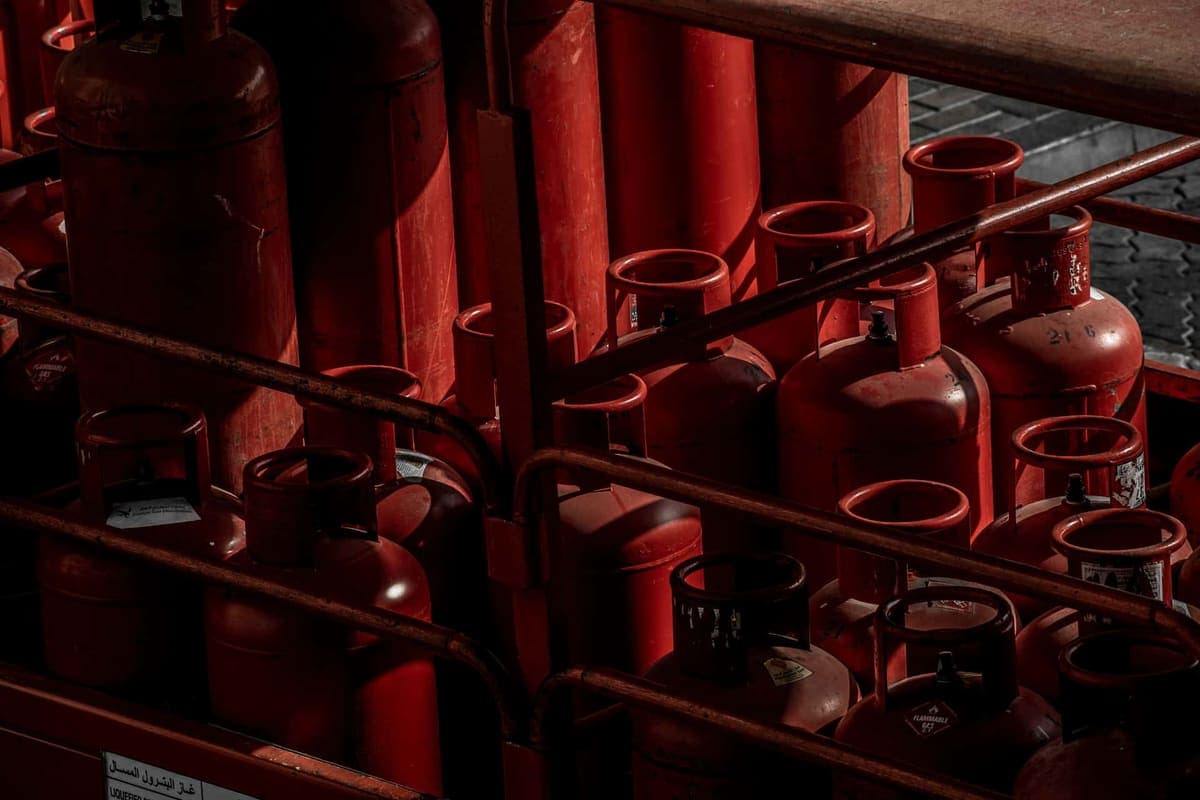
Most portable propane fire pits run a 20 lb cylinder through a supplied regulator and hose. The hose length is fixed and decides how far the cylinder can sit from the pit, which in turn decides your layout. Use the parts that came with the appliance, and leak-check every connection with soapy water.
Cylinder sizes and what they buy
| Cylinder | Approx. gallons | Approx. BTU | Hours at 58,000 BTU/hr |
|---|---|---|---|
| 20 lb (grill size) | 4.7 | 431,000 | 7.4 |
| 30 lb | 7.1 | 647,000 | 11.2 |
| 40 lb | 9.4 | 862,000 | 14.9 |
| 100 lb | 23.6 | 2,156,000 | 37.2 |
All computed at 4.24 lb per gallon and 91,420 BTU per gallon (US DOE). Larger cylinders only work if the appliance manual permits them and the regulator is rated for the setup.
The 20 lb cylinder is the default because it is the one every hardware store, gas station and supermarket exchanges. Stepping up to a 30 or 40 lb cylinder scales runtime proportionally and costs you the convenience of the exchange network, since larger cylinders usually need refilling rather than swapping. For a fixed installation used often, that trade is usually worth it. For a pit you use monthly, it is not.
The hose length is a constraint you buy
This is the thing that surprises people after the pit arrives. The hose that comes with a portable propane fire pit is a fixed length, and it is short — typically enough to put the cylinder just outside the seating circle and no further. That length dictates where the cylinder sits, which dictates where the pit sits, and both have to work with the clearance your local rules require and with where people are going to walk.
Plan it before you buy, not after. Sketch where the pit goes, where the cylinder goes, and where the hose runs across. If the hose crosses a walkway, that is a trip hazard you will live with every time you use it. Extending or substituting the hose is not a casual modification: the regulator and hose are matched to the appliance and rated together.
What the regulator does
A cylinder holds propane as a liquid under its own vapor pressure, and that pressure varies substantially with temperature — much higher on a hot afternoon than a cold morning. The burner needs a steady, much lower pressure to produce a consistent flame. The regulator is the device that takes a varying high supply pressure and delivers a constant low one. It is not an accessory, and it is matched to the appliance.
The leak check, which takes two minutes
- 1Connect everything with the burner valve closed. Hand-tighten the cylinder coupling; it does not need a wrench and over-tightening damages the seal.
- 2Mix washing-up liquid and water, roughly half and half, in a spray bottle or a cup.
- 3Open the cylinder valve slowly, a quarter turn at a time. Opening it fast can trip the excess-flow device in the coupling, which then limits gas to a trickle.
- 4Brush or spray the solution on every joint — the cylinder coupling, both hose ends, the regulator connections.
- 5Watch for growing bubbles. Steady bubbles mean a leak. Close the valve, disconnect, reseat the connection and test again.
- 6If it still leaks, stop. Replace the part rather than tightening harder.
Cold weather, and why the flame drops
Propane's vapor pressure falls as temperature falls. Below roughly freezing, a nearly-empty 20 lb cylinder can struggle to supply a 58,000 BTU/hr burner at full output — you will see the flame fade and the cylinder frost. The fix is a fuller cylinder (more liquid surface area to vaporize from), a larger cylinder, or accepting a lower burner setting. It is physics rather than a fault, and it is why winter evenings feel like they use more gas.
Storing a cylinder
- Outdoors, always. Never in a house, a basement or an attached garage.
- Upright and secured, so the safety relief valve is in the vapor space where it is designed to be.
- Out of direct sun in hot weather, and away from the pit itself.
- Valve closed whenever the appliance is not in use, including between evenings.
- Check the collar date. Cylinders carry a manufacture date and require requalification after a set period; exchange stations handle this automatically, refill stations check it.
Pits these apply to
| # | Product | Best for | Key spec | Price |
|---|---|---|---|---|
| 1 |  Outland Living Firebowl 893 Deluxe58,000 BTU, CSA-certified, and the pit most often accepted where wood fires are not. The cover and carry kit are in the box, which is why this is the one to buy over the bare 823. | Burn bans and travel | 58,000 BTU/hr | $159.99 · View on Amazon |
| 2 |  Endless Summer 30 in Gas Fire Pit TableA 30 in table whose base swallows the 20 lb cylinder. That is the entire point of a fire table, and it is the reason to pay the premium over a bowl. | Hiding the tank | 30,000 BTU/hr | $229.99 · View on Amazon |
Prices are pulled live from Amazon. Where no live price is showing, the button reads “check price” rather than a number we cannot stand behind.
Outland Living Firebowl 893 Deluxe
Outland Living58,000 BTU, CSA-certified, and the pit most often accepted where wood fires are not. The cover and carry kit are in the box, which is why this is the one to buy over the bare 823.
58,000 BTU, CSA-certified, and the pit most often accepted where wood fires are not. The cover and carry kit are in the box, which is why this is the one to buy over the bare 823.
- CSA certification is the thing an HOA or a campground manager actually asks to see
- No embers, so it is the defensible choice under a covered patio and during most burn bans
- Shuts off instantly, which removes the entire put-it-out problem
- A 1-year warranty is the shortest in this whole registry
- A 20 lb tank has to live somewhere, and the hose length dictates where the pit can sit
- 58,000 BTU is a burner rating, not a measure of how warm you will feel
Anyone in a burn-ban county, on a covered patio, in an HOA, or towing it to a campsite.
You want the smell and the sound of a wood fire. A gas flame is not a substitute, and pretending otherwise wastes your money.
We have not burned this unit. These are the things a specification sheet cannot answer, listed rather than glossed over.
- Real-world runtime, which depends on how low you run the burner. Our figure is arithmetic at full output
- Long-run corrosion on the powder-coated bowl in coastal air
#ad how we are funded · price as of October 18, 2026
Endless Summer 30 in Gas Fire Pit Table
Endless SummerA 30 in table whose base swallows the 20 lb cylinder. That is the entire point of a fire table, and it is the reason to pay the premium over a bowl.
A 30 in table whose base swallows the 20 lb cylinder. That is the entire point of a fire table, and it is the reason to pay the premium over a bowl.
- The cylinder and the control panel disappear, which is the whole design brief
- 30,000 BTU nearly doubles runtime per tank against a 58,000 BTU bowl
- The ledge around the burner is usable surface, unlike a bowl
- 30,000 BTU is genuinely less heat, not just a slower burn
- 24 in tall and heavy, so this does not travel
- Fire glass and lava rock are consumables that discolor
A patio where the pit doubles as the table and the propane tank must not be visible.
Heat is the priority. Buy BTU in a bowl instead.
We have not burned this unit. These are the things a specification sheet cannot answer, listed rather than glossed over.
- Resin mantel durability under direct sun over several seasons
- Whether the enclosed base affects tank temperature in hot weather. The listing does not say
#ad how we are funded · price as of October 18, 2026
- Runtime figures are computed from the DOE energy content of propane and scale linearly with cylinder size.
- Everything about hoses, regulators and connections defers to the appliance manual, which is the only authority for a specific model.
- What we did not do: test any hose, regulator or connection.
We have not burned any of these units, and we do not claim to have. The full method, including what it cannot tell you.