How Much Propane Does a Fire Pit Use?
A 20 lb tank holds about 430,000 BTU. Divide by the burner rating and you have your answer. Here is that division, done properly, for every common rating.
DisclosureWe earn a commission when you buy through the links on this page, at no extra cost to you. Prices come from Amazon and change without notice. How this site is funded.
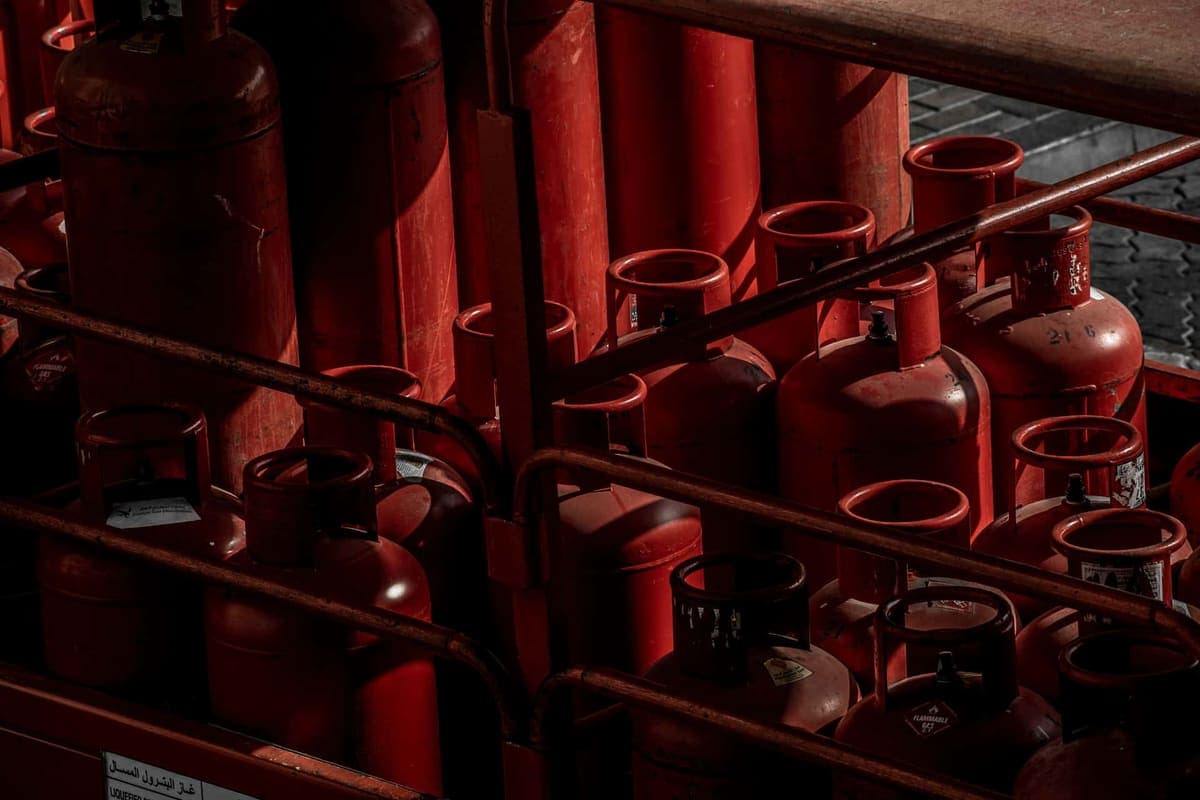
A full 20 lb propane cylinder holds roughly 430,000 BTU. At 58,000 BTU/hr — the most common portable fire pit rating — that is about 7.4 hours at full output, or three typical evenings. A 30,000 BTU/hr fire table runs about 14.3 hours on the same tank.
The two constants everything rests on
This calculation needs exactly two published figures, and both are stable. Propane's liquid density at 60F is 4.24 lb per gallon — the reference temperature the propane industry uses for custody transfer and billing. A 20 lb cylinder therefore holds about 4.7 gallons when full. Propane's higher heating value is 91,420 BTU per gallon, per the US Department of Energy's Alternative Fuels Data Center. The lower heating value in the same table is 84,250 BTU per gallon; we use the higher figure because that is the convention appliance ratings are quoted against.
(20 / 4.24) x 91,420
431,226 BTU per full tank
Burn hours by burner rating
| Burner rating | Hours per tank | 2.5 hr evenings | Typical product |
|---|---|---|---|
| 30,000 BTU/hr | 14.4 | 5-6 | Standard fire table |
| 40,000 BTU/hr | 10.8 | 4 | Compact gas bowl |
| 50,000 BTU/hr | 8.6 | 3-4 | High-output fire table |
| 58,000 BTU/hr | 7.4 | 3 | Most portable propane bowls |
| 60,000 BTU/hr | 7.2 | 2-3 | Large gas bowls and burners |
Divide 431,226 by the rating. Every one of these is full output — the practical figure is longer, because almost nobody runs a fire pit wide open all evening.
The most useful thing in that table is the top row against the bottom. A fire table at 30,000 BTU runs twice as long per tank as a bowl at 58,000, and that is not efficiency — it is simply a smaller fire. If refilling tanks is the thing you dislike about propane, a lower-rated appliance solves it, at the cost of the heat you bought it for.
Why your real runtime will be longer
- Nobody runs full output all evening. Most people light it high and turn it down. At half output you roughly double the hours.
- Cylinders are filled by weight to a nominal 20 lb, and the exchange cylinder you picked up may hold slightly less.
- Cold weather reduces tank pressure, which can limit the flame you can actually draw before the tank ices up — a real effect below about 30F.
- Wind makes you turn it up, which cuts the other way.
How much does a fire table use?
431,226 / 30,000
14.4 hours at full output
Running two tanks
A single 20 lb cylinder is enough for an evening with margin. The practical annoyance is that it runs out mid-evening rather than between them, so the standard fix is simply to own two and swap. If the pit is a fixed installation and you use it often, a larger cylinder — 30 or 40 lb — multiplies the runtime proportionally, subject to the regulator and hose being rated for it and the manufacturer permitting it. Tanks, hoses and regulators.
The pits these figures are for
| # | Product | Best for | Key spec | Price |
|---|---|---|---|---|
| 1 |  Outland Living Firebowl 893 Deluxe58,000 BTU, CSA-certified, and the pit most often accepted where wood fires are not. The cover and carry kit are in the box, which is why this is the one to buy over the bare 823. | Burn bans and travel | 58,000 BTU/hr | $159.99 · View on Amazon |
| 2 |  Endless Summer 30 in Gas Fire Pit TableA 30 in table whose base swallows the 20 lb cylinder. That is the entire point of a fire table, and it is the reason to pay the premium over a bowl. | Hiding the tank | 30,000 BTU/hr | $229.99 · View on Amazon |
| 3 |  Outland Living Firebowl 883 MegaThe 893's burner in a 24 in bowl. The same 58,000 BTU spread over more area, which buys presence rather than heat. | A bigger gas flame | 58,000 BTU/hr | $214.99 · View on Amazon |
Prices are pulled live from Amazon. Where no live price is showing, the button reads “check price” rather than a number we cannot stand behind.
Outland Living Firebowl 893 Deluxe
Outland Living58,000 BTU, CSA-certified, and the pit most often accepted where wood fires are not. The cover and carry kit are in the box, which is why this is the one to buy over the bare 823.
58,000 BTU, CSA-certified, and the pit most often accepted where wood fires are not. The cover and carry kit are in the box, which is why this is the one to buy over the bare 823.
- CSA certification is the thing an HOA or a campground manager actually asks to see
- No embers, so it is the defensible choice under a covered patio and during most burn bans
- Shuts off instantly, which removes the entire put-it-out problem
- A 1-year warranty is the shortest in this whole registry
- A 20 lb tank has to live somewhere, and the hose length dictates where the pit can sit
- 58,000 BTU is a burner rating, not a measure of how warm you will feel
Anyone in a burn-ban county, on a covered patio, in an HOA, or towing it to a campsite.
You want the smell and the sound of a wood fire. A gas flame is not a substitute, and pretending otherwise wastes your money.
We have not burned this unit. These are the things a specification sheet cannot answer, listed rather than glossed over.
- Real-world runtime, which depends on how low you run the burner. Our figure is arithmetic at full output
- Long-run corrosion on the powder-coated bowl in coastal air
#ad how we are funded · price as of October 18, 2026
Endless Summer 30 in Gas Fire Pit Table
Endless SummerA 30 in table whose base swallows the 20 lb cylinder. That is the entire point of a fire table, and it is the reason to pay the premium over a bowl.
A 30 in table whose base swallows the 20 lb cylinder. That is the entire point of a fire table, and it is the reason to pay the premium over a bowl.
- The cylinder and the control panel disappear, which is the whole design brief
- 30,000 BTU nearly doubles runtime per tank against a 58,000 BTU bowl
- The ledge around the burner is usable surface, unlike a bowl
- 30,000 BTU is genuinely less heat, not just a slower burn
- 24 in tall and heavy, so this does not travel
- Fire glass and lava rock are consumables that discolor
A patio where the pit doubles as the table and the propane tank must not be visible.
Heat is the priority. Buy BTU in a bowl instead.
We have not burned this unit. These are the things a specification sheet cannot answer, listed rather than glossed over.
- Resin mantel durability under direct sun over several seasons
- Whether the enclosed base affects tank temperature in hot weather. The listing does not say
#ad how we are funded · price as of October 18, 2026
Outland Living Firebowl 883 Mega
Outland LivingThe 893's burner in a 24 in bowl. The same 58,000 BTU spread over more area, which buys presence rather than heat.
The 893's burner in a 24 in bowl. The same 58,000 BTU spread over more area, which buys presence rather than heat.
- A wider flame pattern reads much better as a backyard centerpiece
- Identical burner rating to the 19 in model, so running cost is unchanged
- Cover included
- The same BTU over more area means lower flame height, not more heat
- A larger footprint eats into patio clearance
- Heavier and more awkward to move than the 893
A fixed patio spot where the pit is the visual centerpiece.
You are buying for heat. The number that matters did not change.
We have not burned this unit. These are the things a specification sheet cannot answer, listed rather than glossed over.
- Whether the wider bowl changes perceived warmth at seated distance. Nobody publishes that
#ad how we are funded · price as of October 18, 2026
- Runtime is computed from two published constants: propane's density at 60F and its higher heating value per the US Department of Energy.
- Every pick's runtime row is marked as computed, not published — the makers do not state it.
- What we did not do: run a tank down on any of these, or measure consumption.
We have not burned any of these units, and we do not claim to have. The full method, including what it cannot tell you.
A last note on why this page exists. Of every competitor page we examined in this category, none published burn-hours per tank by BTU rating — the arithmetic is trivial and nobody had done it. That gap is the whole reason this site can compete without a test lab: published inputs plus visible arithmetic is a method a reader can check, and it does not expire the way a tested-in-2024 verdict does. How we research.